A single dental implant in Ontario typically costs $3,000 to $6,500 CAD all in. That price covers three parts: the titanium post, the abutment that connects it, and the crown on top. In Toronto, complete single-tooth quotes usually land between $3,500 and $6,500. Preparation work is priced separately — an extraction adds $200 to $600, a bone graft $500 to $3,000, and a sinus lift $1,500 to $3,000.

Those are the honest numbers up front. The rest of this guide breaks the price into its parts, explains why two Ontario quotes for the same tooth can differ by thousands, sets out exactly what private insurance and the Canadian Dental Care Plan do and do not pay for, and shows you how to get a written number for your own mouth. At Woodbine & Danforth Dental Care in Toronto, patients on the Danforth ask us about this every week.
How Much Does a Dental Implant Cost in Ontario?
The single biggest factor is how many teeth you are replacing. Here is what a complete, finished result typically costs across Ontario in 2026.
| What you are replacing | Typical Ontario cost (CAD) |
|---|---|
| One tooth — implant, abutment and crown | $3,000 – $6,500 |
| Two or three teeth on an implant-supported bridge | $6,000 – $15,000 |
| A full arch of fixed teeth (All-on-4 style), per jaw | $20,000 – $35,000+ |
| Both arches, full-mouth fixed teeth | $40,000 – $70,000+ |
These are market ranges across the province, not a fee schedule and not our office’s prices. No dentist can quote you from a table, because the number depends on your bone, your gums and how much preparation your mouth needs first. What a table can do is tell you whether a quote you have been handed sits inside the normal range.
What You Are Actually Paying For
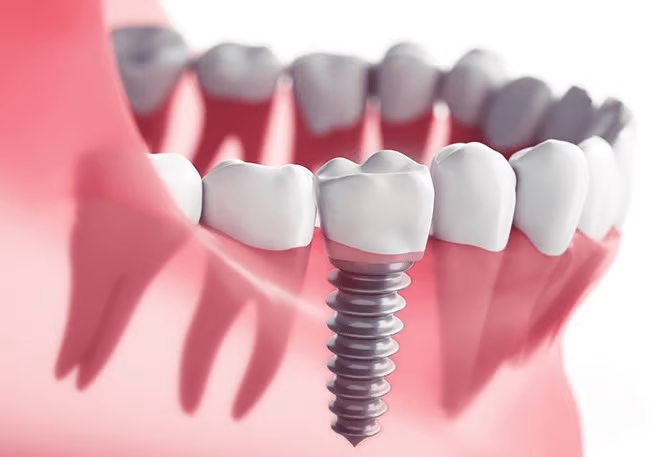
An implant is not one item. It is a small assembly of separately billed parts, plus the planning that goes with them. Seeing it itemised is the fastest way to understand a quote.
| Part of the treatment | Typical Ontario cost (CAD) | What it is |
|---|---|---|
| The implant post | $1,500 – $2,500 | The titanium screw placed into the jawbone to act as the root |
| The abutment | $300 – $1,000 | The connector that joins the post to the crown |
| The crown | $1,000 – $2,500 | The visible tooth, made in a dental lab |
| 3D CBCT planning scan | $230 – $450 | A three-dimensional scan of the jaw used to plan the surgery |
Add those together and you arrive at the $3,000 to $6,500 range. If a quote looks dramatically lower, it is usually because it prices only the surgical placement and leaves the abutment and crown for later. Ask which of the three parts a number includes before you compare it with anything else.
The Costs That Come Before the Implant
An implant needs a healthy, solid foundation. If your mouth is not ready, the preparation is a separate procedure with its own fee — and this is where most of the difference between two quotes actually lives.
| Preparation step | Typical Ontario cost (CAD) | When it is needed |
|---|---|---|
| Tooth extraction | $200 – $600 per tooth | The damaged tooth is still in place |
| Bone graft | $500 – $3,000 per site | There is not enough bone width or height to hold an implant |
| Sinus lift | $1,500 – $3,000 | Upper back teeth, where the sinus floor sits too low |
| Gum disease treatment | $150 – $500 per quadrant | There is active periodontal infection to clear first |
| Sedation or general anaesthetic | $500 – $2,000+ | Dental anxiety, or a long multi-implant surgical visit |
Extractions and grafting are handled through our oral surgery service, and gum treatment through periodontics. Our guide to teeth cleaning costs in Toronto explains how scaling is billed by quadrant, if gum treatment turns out to be your first step.
What Makes One Quote Higher Than Another
Two Ontario clinics can look at the same missing tooth and produce quotes thousands of dollars apart. These are the six reasons why.
How many teeth you are replacing
Replacing one tooth is the simplest case. Replacing several teeth, or a full arch, needs more implants, more planning and more lab work — but the cost per tooth falls as the count rises. Two implants can carry a three-tooth bridge, and four implants can carry a full arch, which is why an All-on-4 case costs far less than twelve individual implants would. If you are missing most or all of your teeth, our full mouth reconstruction page explains how larger cases are planned, and our full mouth reconstruction guide walks through the stages.
The implant and crown materials you choose
Titanium is the most common implant material because it is strong and bonds reliably with bone. Zirconia is an alternative. The crown can be porcelain, porcelain fused to metal, or zirconia, and each has a different look, strength and price. Premium implant systems and custom-milled abutments also add to the total. When people compare implant costs between clinics, materials are often the hidden variable.
Whether your mouth needs preparation first
A straightforward case with good bone and healthy gums sits at the bottom of the range. Add an extraction, a graft and a healing period, and the same tooth moves toward the top. This is not padding — it is the work that decides whether the implant lasts.
Sedation and case complexity
Most implants are placed with local freezing alone. Some patients choose sedation for comfort, which is billed separately. Cases near a nerve, in thin bone, or across several sites take more chair time and more planning, and are priced accordingly.
Training, planning and technology
Placing implants predictably takes advanced training and equipment — a CBCT scanner, digital planning software and guided surgical stents. A practice that has invested in these may charge more per case, and that investment shows up in how closely the finished tooth matches the plan.
Where the clinic is located
Overhead follows rent. A dental implant cost in Toronto generally runs higher than in a smaller Ontario town, and downtown clinics tend to sit at the top of the city’s range. Neighbourhood practices on the Danforth commonly land in the middle of it.
The ODA Suggested Fee Guide, and Why Ontario Quotes Vary
Every year the Ontario Dental Association publishes a Suggested Fee Guide listing a recommended fee and a procedure code for each dental service. Many Ontario dentists use it as a reference point, and insurance companies frequently build their coverage tables around it.
Here is the part patients are rarely told. The ODA states plainly that dentists are “not required to follow the Guide or any fee schedule” and that “your dentist’s fees may vary both above and below the Guide.” You can read the association’s own explanation on its dental costs explained page. That single fact accounts for most of the spread you see when you phone three Ontario clinics about the same tooth.
The practical defence is an itemised treatment plan. Ask for the procedure code and fee for each step — surgical placement, abutment, crown, scan, graft — so you are comparing the same work rather than two different bundles.
Does Insurance or the CDCP Cover Dental Implants?
This is where expectations and reality part company most often, so here is the current position for an Ontario patient.
- Private insurance. Many plans pay a share of implant treatment under major or restorative benefits, but some exclude implants by name. Most plans also carry an annual maximum, and a single implant can consume an entire year’s benefit on its own. Ask your insurer for a written pre-determination before you start.
- The Canadian Dental Care Plan (CDCP). Dental implants are not among the services the CDCP covers. The plan’s list of covered oral health care services runs to exams, cleanings, fillings, root canals, extractions, crowns with preauthorization, and complete and partial dentures. If tooth replacement is the goal and the CDCP is your coverage, a denture is the route the plan will help with.
- The Ontario Seniors Dental Care Program (OSDCP). Low-income seniors aged 65 and over can receive check-ups, fillings, extractions, gum treatment and partial denture coverage through the provincial program. Implants are not on its covered list either.
- OHIP. Ontario’s health plan does not pay for dental implants.
- Payment plans. Many clinics, ours included, spread treatment over monthly instalments so the cost does not have to land in a single year.
Are Dental Implants Worth the Cost?
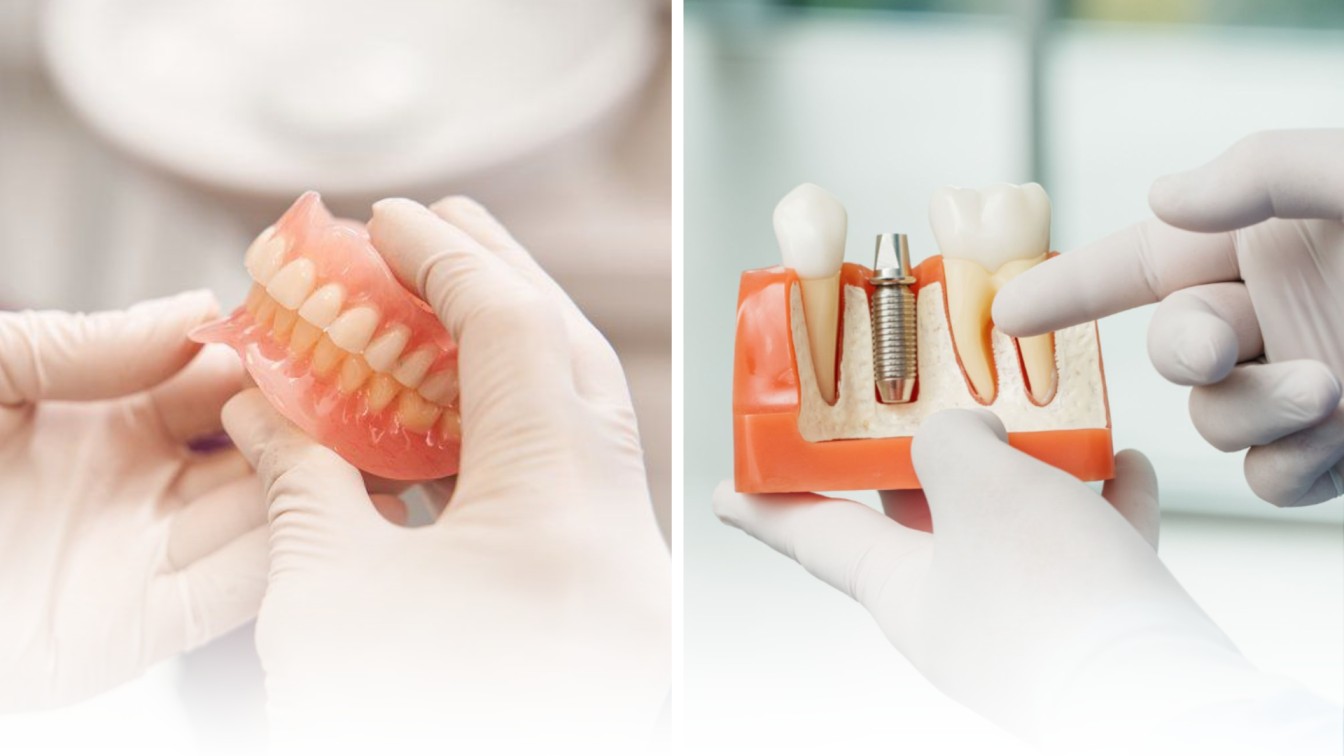
An implant is the most expensive way to replace one tooth on day one. Whether it is the most expensive over fifteen years is a different question, and the answer usually turns on what the alternative does to the teeth around it.
| Option | Typical Ontario cost (CAD) | The trade-off |
|---|---|---|
| Single implant and crown | $3,000 – $6,500 | Stands alone and preserves jawbone, but the highest upfront cost |
| Three-unit conventional bridge | $2,500 – $4,500 | Faster, but two healthy neighbouring teeth are filed down to carry it |
| Partial denture, per arch | $500 – $1,500 | Lowest cost, removable, needs relining as the jaw changes shape |
| Complete denture, per arch | $1,000 – $2,200 | Replaces a full arch, but does nothing to slow bone loss |
Three things justify the difference for many patients. An implant replaces the root, so it keeps the jawbone stimulated instead of letting it shrink. It stands on its own, so no healthy tooth is cut down to support it. And it is fixed in place, so eating and speaking feel closer to a natural tooth. Against that, a bridge or a denture can be an entirely sensible choice — particularly when several teeth are involved or bone volume is limited.
It is worth reading the alternatives properly before deciding. Our guides to dental bridges, their types, cost and lifespan and to dentures for missing teeth cover both in detail, and our dental bridges and full and partial dentures pages explain how we provide them on the Danforth.
How to Get an Accurate Implant Quote in Toronto

The only number that matters is the one written for your mouth. A proper implant consultation produces it in four steps: an examination of the teeth and gums around the gap, a 3D CBCT scan to measure the bone, a discussion of which replacement options suit your case, and then a written, itemised plan.
A quote worth trusting shows the implant, the abutment and the crown as separate lines, names any preparation such as extraction or grafting, states which procedure codes are being billed, and says what your insurance is expected to pay. Bring your policy details to the appointment so the estimate can be built around your actual coverage. Our single tooth implant page sets out what the treatment involves, and our step-by-step guide to getting a dental implant walks through the timeline from consultation to final crown. The crown itself is made much like any other — our dental crowns page explains the materials.
Dental Implant Costs on the Danforth and in East York
Toronto sits at the higher end of Ontario’s implant range because clinic overhead in the city is higher. But that range is wide, and where a practice sits inside it has more to do with the case than the postcode. A straightforward single implant with good bone is priced very differently from the same tooth needing an extraction, a graft and a healing period first.
Woodbine & Danforth Dental Care serves patients across the Danforth, East York, Greektown, the Woodbine Corridor and the surrounding east-end neighbourhoods. If you already have a quote from another clinic and simply want to understand what is in it, bring it in — we will walk you through what each line covers.
Frequently Asked Questions
How much is a single dental implant in Ontario?
A complete single implant — post, abutment and crown — typically costs $3,000 to $6,500 CAD in Ontario, and $3,500 to $6,500 in Toronto. Broken down, the post runs about $1,500 to $2,500, the abutment $300 to $1,000 and the crown $1,000 to $2,500. Preparation such as an extraction or a bone graft is billed separately.
Why do dental implant quotes vary so much in Ontario?
Because the ODA Suggested Fee Guide is a recommendation rather than a rule — the Ontario Dental Association states dentists are not required to follow it and that fees may fall above or below it. Quotes also differ because they bundle different things: one may include the abutment and crown, while another prices only the surgical placement.
Are dental implants covered by insurance in Canada?
Sometimes, in part. Many private plans pay a share under major or restorative benefits, though some exclude implants outright and most carry an annual maximum that one implant can use up. The Canadian Dental Care Plan does not list implants among its covered services, the Ontario Seniors Dental Care Program does not cover them either, and OHIP does not pay for them.
How much do full mouth dental implants cost in Ontario?
A full arch of fixed teeth on implants, the All-on-4 approach, typically costs $20,000 to $35,000 or more per jaw in Ontario. Doing both arches generally runs $40,000 to $70,000 or more. The final figure depends on how many implants are used, whether extractions or grafting are needed, and whether the bridge is acrylic or zirconia.
How much does a bone graft add to the cost of an implant?
A bone graft typically adds $500 to $3,000 per site in Ontario, and a sinus lift for an upper back tooth adds roughly $1,500 to $3,000. Not every patient needs either — a CBCT scan shows whether there is enough bone before anything is booked.
How long do dental implants last?
With good oral hygiene and regular checkups, the implant post is designed to be a long-term solution and often lasts decades. The crown on top is the part more likely to need replacing over time. Results vary from person to person, and smoking and untreated gum disease both shorten the odds.
Is a dental implant cheaper than a bridge or a denture?
Not upfront. A three-unit bridge in Ontario runs about $2,500 to $4,500 and a partial denture $500 to $1,500 per arch, against $3,000 to $6,500 for one implant. The case for the implant is what it avoids: no healthy teeth filed down to carry a bridge, and a root left in place to slow the bone loss that follows a missing tooth.
Book Your Dental Implant Consultation on the Danforth
If you are missing a tooth, or you are holding a quote you would like explained, the team at Woodbine & Danforth Dental Care would be glad to help. We will examine your mouth, take the scan needed to plan properly, set out your options in plain language, and give you a written, itemised estimate before anything is booked.
Call us at (416) 696-1800 or book a consultation to get a number that reflects your mouth rather than a national average.
Cost ranges in this guide reflect the Ontario dental market as of September 2026 and are provided for general information. They are not a quote, and they are not our fee schedule. Fee guide information is drawn from the Ontario Dental Association; coverage details from the Canadian Dental Care Plan and the Ontario Seniors Dental Care Program.
Keep Reading