If you are scared of the dentist, or the thought of a visit makes your stomach turn, you are not alone. Dental anxiety is one of the most common reasons people put off care, and it is also one of the most manageable. For most people, a calmer appointment comes from three things: a dental team that explains every step and lets you pause, a few simple coping techniques, and, when anxiety runs deeper, sedation dentistry.
At Woodbine & Danforth Dental Care, we care for nervous patients from the Danforth and East York every week. This guide explains where dental fear comes from, practical ways to feel calmer, how the different levels of sedation work, what is available at our clinic, and how to take the first step without any pressure.
How Common Are Dental Anxiety and Dental Phobia?
Very common. A 2021 review of 31 studies covering more than 72,000 adults estimated that about 15% of adults worldwide live with dental fear or anxiety, and around 3% have severe fear. It was more common among women and younger adults.
Anxiety sits on a spectrum. For some people, it is mild butterflies in the waiting room. For others, it is a fear of the dentist strong enough to cancel appointments for years, which is often called dental phobia. Wherever you fall, it is worth telling your dental team, because the right approach depends on how you actually feel.
What Causes Dental Anxiety?
Knowing your triggers is the first step to managing them. Common ones include:
- A painful or frightening experience in the past, often in childhood
- Fear of needles, or of the sounds and smells of a dental office
- Feeling a loss of control while lying back in the chair
- Embarrassment or worry about being judged for the state of your teeth
- A strong gag reflex, or worry about breathing comfortably
- General anxiety that makes any medical appointment feel harder
Once your dentist knows what worries you most, they can change how they work, from explaining each step before it happens to building in more breaks.
How to Overcome Dental Anxiety: 8 Tips for Your Next Appointment
You do not need sedation to feel more relaxed. These practical dental anxiety tips help many nervous patients:
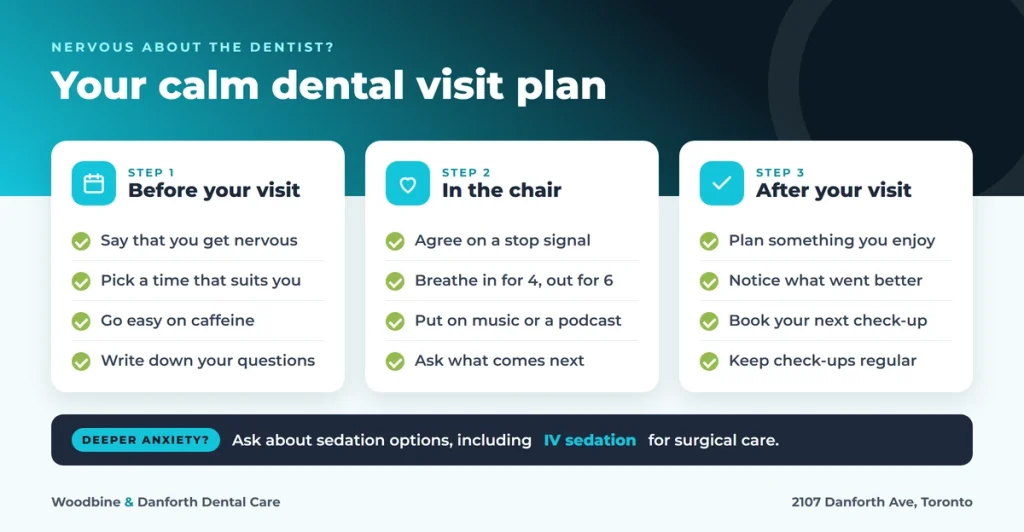
- Tell the team when you book. Saying “I get nervous at the dentist” lets everyone slow down and plan a little extra time.
- Agree on a stop signal. A raised hand that means “pause” puts you back in control.
- Ask for a step-by-step explanation. Knowing what is coming next, and roughly how long it will take, takes the surprise out of each step.
- Bring headphones. Music or a podcast masks the sounds that bother you most.
- Try slow breathing. Breathe in for a count of four and out for a count of six. A longer exhale helps your body settle.
- Choose a time that suits you. Some people prefer an early slot before worry builds; others prefer an evening appointment once the day is done.
- Go easy on caffeine beforehand. Coffee and energy drinks can make a racing heart feel worse.
- Start small. A check-up and cleaning is a gentle way to rebuild trust before any bigger treatment.
These habits pair well with the unhurried style of our general dentistry visits. At our clinic, we move at your pace, explain every step before it happens, and never make you feel rushed or judged.
What Is Sedation Dentistry?
Sedation dentistry uses medication to help you relax during treatment. It is different from freezing: local anaesthetic numbs the area being treated, while sedation calms your mind. The two are often used together.
In Ontario, the Royal College of Dental Surgeons of Ontario (RCDSO) regulates sedation and describes it in levels:
- Minimal sedation (nitrous oxide and oxygen, or a mild oral sedative): you are relaxed but awake and can talk normally.
- Moderate sedation: you are drowsy but still respond when spoken to.
- Deep sedation: you are not easily roused, but you respond to repeated or firm stimulation.
- General anaesthesia: you are fully unconscious.
According to the RCDSO, dentists need authorization from the College to provide any level of sedation, including minimal sedation. Clinics that offer oral moderate sedation, IV sedation, deep sedation or general anaesthesia also need a current facility permit, and the College inspects dental offices as part of its patient-safety requirements.
The main types of dental sedation
- Laughing gas (nitrous oxide): breathed through a small nose mask. It takes effect within minutes and wears off quickly once the mask comes off.
- Oral sedation: a prescribed pill taken before your appointment. You stay awake but feel drowsy, and you will need someone to take you home.
- IV sedation dentistry: medication given through a vein. It works quickly, can be adjusted during treatment, and is often used for surgical procedures such as wisdom tooth removal. A responsible adult needs to take you home afterwards.
- General anaesthesia: reserved for specific cases and provided with specialized monitoring.
Here is how the four types compare:
| Type of sedation | How it is given | How you feel | After your visit |
|---|---|---|---|
| Laughing gas (nitrous oxide) | Breathed through a small nose mask | Relaxed but awake, and able to talk normally | Wears off quickly; many people can drive once fully recovered |
| Oral sedation | A prescribed pill taken before your appointment | Awake but drowsy | Someone needs to take you home |
| IV sedation | Medication given through a vein | Deeply relaxed and drowsy; many people remember little afterwards | A responsible adult needs to take you home |
| General anaesthesia | Given with specialized monitoring, for specific cases | Fully unconscious | A responsible adult needs to take you home |
Comfort options at our Danforth clinic
If you live in Toronto’s east end, here is what to expect when you visit us. For surgical care, such as wisdom teeth extraction and other oral surgery, we use local anaesthetic (freezing) to numb the area, and we give you a quick rundown of the procedure before we begin. You can start with a free consultation at our Danforth clinic, with no charge and no obligation.
If you are anxious about a routine visit, tell us when you book and ask which comfort options suit your treatment. For many people, a slower pace, clear explanations, and regular breaks make a cleaning or a filling far easier.
Is Sedation Dentistry Safe?
For most healthy adults, sedation provided by a trained, authorized dentist is considered safe. Safety comes from preparation: your dentist reviews your medical history and medications, chooses the lightest level that will keep you comfortable, and monitors you throughout treatment.
Before your appointment, tell your dentist about any heart or lung condition, sleep apnea, pregnancy, and every medication or supplement you take, and follow the instructions you are given about eating and drinking beforehand. After oral or IV sedation, you will usually be asked to arrange for a responsible adult to take you home and stay with you for a while, and to avoid driving, operating machinery, or making important decisions for the rest of the day.
What Does Sedation Dentistry Cost?
There is no single price for sedation dentistry in Toronto. The cost depends on the type of sedation, how long the treatment takes, and the level of monitoring required. Laughing gas generally costs the least, while IV sedation and general anaesthesia cost more because they involve more time, equipment, and monitoring.
Coverage varies from plan to plan. Some private dental plans pay part of the cost of sedation when it is needed for a procedure such as oral surgery, while others do not. Check your plan booklet or call your insurer before treatment, and ask for an estimate so you know what to expect.
Helping Children Feel Comfortable at the Dentist
Children often pick up on the feelings of the adults around them, so a calm, matter-of-fact approach goes a long way:
- Use neutral words such as “the dentist will count and check your teeth” rather than “it won’t hurt”
- Avoid scary words and stories about your own bad experiences
- Read a picture book about visiting the dentist, or practise “counting teeth” at home
- Book appointments when your child is rested and fed
- Start early, so the first visit is a simple check-up rather than a problem
Our team provides gentle care for every age, from a child’s first check-up to dentures.
Why Facing Dental Anxiety Is Worth It
Avoiding the dentist can feel easier in the moment, but small problems rarely stay small. A cavity that could be fixed with a quick filling can grow into an infection that needs a root canal or an extraction. Gum disease can progress quietly without much pain, and our gum care page explains why early treatment matters.
That creates a cycle: delayed care leads to bigger treatment, and bigger treatment makes the next visit feel even more daunting. Regular, gentle check-ups break the cycle, because most visits stay short, simple, and predictable.
A Calm, Judgment-Free Dental Visit on the Danforth
Our clinic is led by Dr. Samira Hossain, who describes helping patients overcome their anxiety and fears about dental visits as the most rewarding part of her practice. You will find calm rooms and a team that takes the time to listen before any treatment begins.
We are open evenings until 7 pm and Saturdays until 5 pm, so you can book a time when you are not rushing between commitments; our guide to evening and Saturday dental hours explains what fits into each slot. And if you have been putting off care until something hurts, our emergency dentistry team offers emergency appointments when pain cannot wait.
Frequently Asked Questions
What is the difference between laughing gas and IV sedation?
Laughing gas, or nitrous oxide, is a mild sedative you breathe through a small mask. It works within minutes and wears off quickly once the mask comes off. IV sedation is given through a vein, produces a deeper level of relaxation, and is often used for surgical treatment. After IV sedation, you need a responsible adult to take you home.
What is the best type of sedation for dental anxiety?
It depends on how anxious you feel and the treatment you need. Your dentist will usually suggest the lightest level that keeps you comfortable: laughing gas is often enough for mild or moderate nerves, while IV sedation is more often used for surgical treatment or severe anxiety.
Will I be asleep during sleep dentistry?
Usually not. The term sleep dentistry is often used for IV sedation, which leaves you deeply relaxed and drowsy, and many people remember little of the appointment afterwards. Being fully unconscious requires general anaesthesia, which is used only in specific cases.
Is sedation dentistry safe?
For most healthy adults, sedation given by a trained dentist who holds the required authorization is considered safe. In Ontario, the RCDSO sets the rules for sedation and requires authorization for every level. Share your full medical history and medication list, and follow your pre-appointment instructions.
Can I drive after dental sedation?
Not after oral or IV sedation. Plan for a responsible adult to take you home, and avoid driving, operating machinery, or making important decisions for the rest of the day. After laughing gas alone, many people can drive once they have fully recovered, but always follow your dentist’s advice.
How much does sedation dentistry cost?
It depends on the type of sedation and how long treatment takes. Laughing gas generally costs the least, while IV sedation and general anaesthesia cost more. Some insurance plans cover part of the cost when sedation is needed for a procedure, so check your plan and ask for an estimate before treatment.
How can I calm my nerves before a dental appointment?
Tell the team you are nervous when you book, agree on a stop signal, bring headphones, and practise slow breathing: in for a count of four, out for a count of six. Going easy on caffeine and starting with a simple check-up can also help.
What if I have not been to the dentist in years?
You will not be judged. Let the team know how long it has been, which helps with planning rather than blame, and start with a check-up so your dentist can see where things stand. From there, you can build a treatment plan at a pace that feels manageable.
Do children get dental anxiety too?
Yes. Children often pick up on adults’ worries about the dentist. Using neutral words, avoiding scary stories, and starting with early, positive check-ups all help children feel comfortable and confident.
Book a Calm, Unhurried Visit on the Danforth
You deserve dental care that feels safe and comfortable. Whether you would simply like a slower, gentler visit or you want to talk about sedation dentistry for upcoming treatment, call Woodbine & Danforth Dental Care at (416) 696-1800 or book an appointment online. We are at 2107 Danforth Ave, steps from Woodbine Station, with evening hours until 7 pm and Saturdays until 5 pm.
This article is general information, not medical advice. Whether sedation is right for you depends on your health history and the treatment you need. Prevalence figures come from a 2021 systematic review and meta-analysis; sedation levels and permit rules are described by the Royal College of Dental Surgeons of Ontario.