You’re brushing before bed, you run your tongue along your gums, and there it is — a bump that definitely wasn’t there last week. If you’ve just found one, take a breath. Most bumps on the gums are harmless. The usual causes are canker sores, gum boils from an infected tooth, small cysts, harmless bony growths called tori, or swelling from early gum disease. The main exception: any bump that lasts longer than two weeks, keeps growing, or bleeds easily should be examined by a dentist.
Most people who find one assume the worst, so it helps to know what the common causes look and feel like. This guide covers what that hard lump, white spot, or bubble on your gums most likely is, the symptoms to watch for, how each type is treated, what you can safely do at home, how to prevent new bumps, and the warning signs that mean it’s time to book an exam.
What Does a Bump on Your Gums Mean?
A bump on the gums is any raised spot, lump, blister, or swelling on the gum tissue around your teeth. It can be soft or hard, painful or painless, and white, red, clear, bluish, or the same colour as the rest of your gums. Most bumps fall into one of these groups:
- Infection, such as a gum boil (abscess) from a tooth root or a gum pocket.
- Sores and irritation, such as canker sores, or a fibroma from rubbing.
- Gum disease, when gingivitis makes the gum line puffy and swollen.
- Fluid-filled bumps, such as cysts, mucoceles, and eruption cysts in children.
- Extra bone, such as a torus or exostosis.
- Teeth coming in, especially wisdom teeth, which can cause pericoronitis.
- Rarely, oral cancer, which is why a bump that lasts more than two weeks should be checked.
The rest of this guide walks through each one, how to tell them apart, and how each is treated.
10 Common Causes of a Bump on Your Gums
Gum tissue reacts to irritation, infection, and pressure in a small handful of predictable ways. Here are the most common causes, from the everyday to the rare.
1. A gum boil or abscess (a pimple-like bubble on the gums)
A soft bubble on the gums that looks like a pimple, sometimes with a white or yellow head, is usually a gum boil — and it deserves respect. A gum boil is a drainage vent. There’s an infection at the root of a tooth or deep in a gum pocket, and the pus is tunnelling its way out through the gum.
Because the infection drains from the root of a tooth, a gum boil usually shows up on the gum above the tooth (below it on the lower jaw). Dentists call it a parulis, and the small tunnel it drains through a fistula. On a back tooth, it can feel like a firm bump that comes and goes.
The tell-tale sign is a bubble that pops, leaks a salty or bitter taste, shrinks — and then refills a few days later. Rinsing won’t fix it, because the source of the infection is still inside. Treatment usually means root canal therapy to clean out the infected tooth, or deep gum treatment if the infection started in the gums. And if the bump arrives with a throbbing ache, facial swelling or fever, don’t wait — that’s emergency dentistry territory.
2. Canker sores (a sore white bump)
A canker sore starts as a small, tender red bump and quickly opens into a shallow ulcer with a white or yellow centre and a red border. Canker sores favour the soft tissues of the mouth — the inner lips, cheeks and the edges of the gums — and they sting, especially when salty, spicy or acidic food touches them.
Nobody knows exactly what triggers them; stress, minor injuries, certain foods and hormonal changes all seem to play a role. What we do know is reassuring: they’re not contagious, they’re not dangerous, and most heal on their own within one to two weeks.
3. Gingivitis bumps along the gum line
Not every “bump” is a distinct lump. Early gum disease — gingivitis — makes the gum margins puffy, swollen and tender, which many patients describe as bumps on their gums, especially where hardened tartar has collected along and under the gumline. Bleeding when you brush or floss is the giveaway.
The good news, as the Canadian Dental Association notes, is that early gum disease can almost always be reversed: a professional cleaning to clear the tartar, then solid daily brushing and flossing at home.
4. Cysts and mucoceles (a clear bubble or bluish bump)
A cyst is a small fluid-filled sac. On the gums it feels soft, looks clear, pinkish or bluish, and often forms around a buried or impacted tooth — wisdom teeth are frequent offenders. Mucoceles are a close cousin: harmless mucus-filled bumps that appear when a tiny saliva gland gets blocked or injured, often from lip or cheek biting.
Small cysts are usually painless, which is exactly why they get ignored. Left alone for years, some slowly expand and press on nearby teeth and bone. A quick X-ray shows what’s underneath, and removal is normally a minor procedure.
5. Torus or exostosis (a hard bump on the gums by your molars)
If you’ve found a rock-hard bump on your gums near your molars — often on the tongue side of the lower jaw, and often on both sides — you can probably relax. That’s most likely a torus (plural: tori) or an exostosis: simply extra bone that your body has laid down over the years.
On the inside of the lower jaw, it’s called torus mandibularis, and on the roof of the mouth, it’s torus palatinus. Both seem to run in families and may be linked to heavy biting forces, such as clenching or grinding.
Tori grow extremely slowly, are covered with normal, healthy-looking gum tissue, and are completely benign. They only need attention if they interfere with a future denture or keep getting scraped by crunchy food.
6. Irritation fibroma (a firm, painless growth on the gums)
An irritation fibroma is a smooth, firm, dome-shaped growth, usually the same colour as the surrounding gum or slightly paler. It’s essentially a callus — the mouth’s response to repeated rubbing from a rough tooth edge, a denture or a cheek-biting habit.
Fibromas are the most common benign growth in the mouth. They don’t turn into anything sinister, but they don’t go away on their own either. If one bothers you or keeps growing, removal is a short, simple procedure.
7. Pyogenic granuloma (a red bump that bleeds easily)
This one alarms people because of how it behaves: a soft red or purplish bump that appears out of nowhere, grows quickly, and bleeds at the lightest touch. Despite the dramatic behaviour, pyogenic granulomas are benign overgrowths of tiny blood vessels, usually triggered by irritation or hormonal changes — they’re so common in pregnancy they’ve been nicknamed “pregnancy tumours.”
Some shrink on their own, especially after pregnancy. Persistent ones are removed and sent for routine testing, just to be thorough.
8. Pericoronitis (a swollen flap over a wisdom tooth)
When a wisdom tooth only partly breaks through, a flap of gum can stay over part of it. Food and bacteria get trapped underneath, and the flap swells into a sore, red bump behind your last molar. It can make chewing, swallowing, or opening wide uncomfortable, and it often leaves a bad taste.
Warm salt-water rinses and careful cleaning under the flap can settle a mild flare-up, but pericoronitis tends to come back. If it keeps returning, your dentist may suggest removing the wisdom tooth. Swelling that spreads into your cheek or jaw, a fever, or trouble opening your mouth needs same-day care.
9. Eruption cysts (a bluish bump over a child’s new tooth)
In babies and children, a soft, bluish, or clear swelling can appear on the gum right where a tooth is about to come through. This eruption cyst is a small pocket of fluid, sometimes tinged with blood, sitting over the new tooth. It’s usually painless and normally goes away on its own once the tooth breaks through. If it looks infected, bleeds a lot, or seems to be holding the tooth back, have it checked.
10. Rarely, something more serious
This has to be said, because catching it early matters: a small percentage of persistent mouth lumps are leukoplakia — white or grey patches that can’t be wiped away and are occasionally precancerous — or, rarely, oral cancer. According to the Canadian Cancer Society, warning signs include a lump or sore that doesn’t heal, a patch that bleeds, unexplained numbness, or thickening tissue in the mouth.
For perspective: the overwhelming majority of gum bumps we examine are benign. But “it’s been there for a month, and it’s growing” is never something to sit on. An oral cancer screening takes minutes, and it’s part of every routine exam at our clinic.
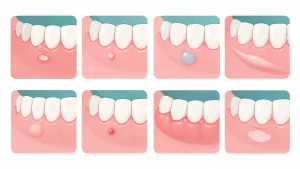
What the Bump’s Look and Feel Is Telling You
You can learn a lot before you ever sit in the chair. Here’s a quick decoder:
| What you notice | Most likely cause | Usual next step |
|---|---|---|
| Hard as bone, near the molars, there for years | Torus/exostosis | Mention it at your next check-up |
| White or yellow centre, stings when you eat | Canker sore | Home care; gone in 1–2 weeks |
| White or grey patch, no pain, won’t wipe off | Leukoplakia | Book an exam |
| Pimple-like bubble that pops and refills | Gum boil (abscess) | See a dentist promptly |
| Soft, clear or bluish | Cyst or mucocele | Exam + X-ray |
| Deep red, bleeds when touched | Pyogenic granuloma | Exam; simple removal if it persists |
| Puffy, tender ridge along the gumline, bleeds when brushing | Gingivitis/tartar | Professional cleaning |
| Throbbing bump plus facial swelling or fever | Spreading dental abscess | Emergency dentist — same day |
| White coating that wipes off, leaving a red patch | Oral thrush (a yeast infection) | See a dentist or doctor |
| Swollen, sore gum flap behind the last molar | Pericoronitis | Dental exam; same day if swelling spreads |
| Soft bluish bump over a new tooth (children) | Eruption cyst | Usually resolves; exam if it hurts or bleeds |
Treat this table as a starting point, not a diagnosis. Some of these conditions look alike, and only an exam — sometimes with an X-ray — can tell them apart for certain.
Symptoms to Watch For With a Bump on the Gums
The bump itself is only part of the picture. What comes with it often tells you more:
- Throbbing pain, or pain when you bite, usually points to an infected tooth or an abscess.
- Pus, a salty or bitter taste, or bad breath suggests a gum boil that is draining.
- Bleeding when you brush or floss is a common sign of gingivitis. A bump that bleeds at the lightest touch may be a pyogenic granuloma.
- A sore, swollen flap behind the last molar, with trouble opening wide, suggests pericoronitis.
- A loose tooth or a tooth that hurts to tap near the bump suggests infection or advanced gum disease.
- Swelling in your face or jaw, fever, or trouble swallowing means an infection may be spreading, and that needs same-day care.
- Numbness, a patch that won’t wipe off, or a sore that won’t heal should be checked promptly to rule out anything serious.
Why Is There a Bump on My Gums That Hurts?
Pain is actually your most useful clue, because it usually means inflammation or infection.
A surface sting that flares when food touches the spot is classic canker sore — annoying, but self-limiting. A deep, throbbing ache that gets worse when you bite down, wakes you at night, or comes with a bad taste in your mouth points to an abscessed tooth, with the bump acting as its pressure valve.
Here’s the part patients don’t love hearing: a painful abscess sometimes stops hurting once the gum boil starts draining. The relief feels like recovery, but the infection is still there — it has simply found an exit. Left untreated, it can damage the bone around the tooth or spread further. If a painful bump comes with swelling in your face or jaw, fever, or trouble swallowing, treat it as a same-day emergency.
Soft, Painless Lump or Clear Bubble on the Gums?
A soft, painless lump on the gum is unsettling because it seems to appear out of nowhere. It’s usually one of these:
- A gum boil that has started draining. Once the pus has an exit, the pressure and the pain ease off. What’s left can look like a soft, clear, or yellowish bubble that shrinks and refills. The infection is still there, so it needs treatment.
- A cyst or mucocele. Soft, fluid-filled, and clear or bluish. Mucoceles are most common inside the lower lip, but small fluid-filled bumps can form on the gums too, often around a tooth that hasn’t fully come in.
- An eruption cyst in a child, sitting over a tooth that is about to come through.
- A fibroma, which feels firmer and rubbery rather than soft, and doesn’t change size from day to day.
A clear bubble that lasts more than two weeks, keeps refilling, or sits over a tooth with a large filling or old decay should be examined. A quick X-ray shows whether the root underneath is involved.
White Bump on the Gums but No Pain?
Painless bumps get ignored the longest — and most of the time, that’s fine. Tori, fibromas, and small cysts don’t hurt. A small white or yellowish bump with no pain is often a gum boil that’s draining quietly, so it still needs to be checked.
If the white spot is a creamy coating that wipes off and leaves a red, sore patch underneath, it may be oral thrush, a yeast infection that’s more common in babies, denture wearers, people with diabetes, and people taking antibiotics or using steroid inhalers. It needs a proper diagnosis and usually an antifungal treatment.
The exception is a flat white or grey patch that can’t be wiped off. That’s leukoplakia until proven otherwise — most patches are harmless, but a small share are precancerous. Painless doesn’t mean safe; it just means quiet. The two-week rule applies double here.
Hard Bump on Gums by a Molar
A hard bump on the gums by a molar has a short list of usual causes:
- A torus or exostosis. Bone-hard, covered by normal-looking gum, often on the tongue side of the lower molars, and often on both sides. It’s harmless and has usually been there for years.
- A wisdom tooth coming through. In teens and young adults, a hard, painless swelling at the very back of the gums is often the crown of a wisdom tooth pushing up. If the gum over it turns sore and swollen, that’s pericoronitis.
- An abscessed molar. A bump on the gum over the roots of a molar, especially one that’s tender when you bite or drains a salty taste, points to an infection that needs root canal treatment or an extraction.
- A bone fragment after an extraction. In the weeks after a tooth is removed, a small, sharp piece of bone can work its way to the surface and feel like a hard bump. It’s usually harmless, and a dentist can smooth or remove it if it keeps catching your tongue. (If you’ve just had a tooth out, here’s what you can eat after a tooth extraction while you heal.)
If you can’t tell which one you have, a quick exam and an X-ray will sort it out.
Bumps on a Child’s or Baby’s Gums
Bumps on a child’s gums are common, and most are part of normal development:
- Teething. Gums often look swollen and feel tender just before a tooth breaks through.
- Eruption cysts. A soft, bluish or clear bubble over a tooth that is about to come in. It usually clears up once the tooth erupts.
- Bohn’s nodules. Tiny white or grey bumps along a newborn’s gums. They are harmless and usually go away on their own within the first few months.
- A gum boil over a baby tooth. A pimple-like bump near a baby tooth that has decay or was injured can mean the tooth is infected, and it needs a dental visit even though the tooth will eventually fall out.
If a bump on your child’s gums is painful, bleeding, growing, or comes with a fever, have a dentist look at it.
Bumps on the Gums During Pregnancy
Pregnancy hormones make gums react more strongly to plaque, so swollen, tender, or bleeding gums are common. Some people also develop a pyogenic granuloma, the red bump that bleeds easily described above, which is why it is nicknamed a “pregnancy tumour.” It is not cancer, and it often shrinks after the baby is born.
Keep brushing and flossing, and keep up with your dental visits. Routine check-ups and cleanings are considered safe during pregnancy, and it helps to tell your dentist that you are pregnant.
Bumps After Dental Work or From Dentures
- After an extraction. A small bone fragment can work its way up through the gum in the weeks after a tooth is removed. It is usually harmless, but swelling or oozing after the first few days should be checked.
- After a root canal. A gum boil should shrink once the tooth is treated. If it stays, or comes back, the infection may not have cleared, so let your dentist know.
- After a filling or crown. A rough edge or leftover dental cement can irritate the gum and cause a small, sore swelling. It is usually a quick fix.
- From dentures. A denture that rubs can cause sore spots, fibromas, and folds of extra tissue along the edge. Having the denture adjusted or relined usually lets the gum settle.
How a Bump on the Gums Is Diagnosed and Treated
Diagnosis is usually quick. A dentist examines the bump, checks the nearby teeth and gums, and takes a digital X-ray if they need to see beneath the surface. Abscesses, cysts, and impacted teeth all show up clearly.
Treatment depends on the cause:
- Gum boil or abscess: drain the infection and treat its source, usually with root canal treatment, a deep gum cleaning, or an extraction. Antibiotics may be added if the infection is spreading.
- Canker sores: they heal on their own. Salt-water rinses and an over-the-counter mouth gel ease the sting.
- Gingivitis and tartar bumps: a professional cleaning and better daily brushing and flossing.
- Pericoronitis: cleaning under the gum flap and rinses, antibiotics if it is spreading, and sometimes removing the wisdom tooth.
- Cysts, fibromas, and pyogenic granulomas: a minor procedure to remove them, with the tissue sent for routine lab testing when appropriate.
- Tori and other bony bumps: usually nothing at all, unless they get in the way of a denture.
- Eruption cysts: usually nothing, because they clear up once the tooth comes in.
- Suspicious patches or sores: prompt assessment, and a referral for a biopsy when needed.
What You Can Do at Home Tonight
While you wait for the bump to settle — or for your appointment — you can keep things calm:
- Rinse with warm salt water two to three times a day: half a teaspoon of salt in a cup of warm water. It soothes the tissue and keeps the area clean.
- Keep brushing, gently, with a soft-bristled brush. Avoiding the area lets plaque pile up and makes things worse.
- Skip the irritants — spicy, acidic, scalding-hot, and sharp, crunchy foods all aggravate sore tissue.
- Use an over-the-counter pain reliever as directed on the label if the area aches.
- Don’t pop, squeeze, or poke the bump. Piercing it pushes bacteria deeper and can turn a contained problem into a spreading one.
One honest caveat: home care soothes symptoms, but it can’t cure an infected tooth, remove a cyst, or shrink a fibroma. If the bump is still there in two weeks, it’s telling you it needs professional attention.

How to Prevent Bumps on Your Gums
You can’t prevent every bump (tori, for example, seem to run in families), but you can lower the odds of the common ones:
- Brush twice a day and floss once a day to keep tartar and gingivitis from building up along the gum line.
- Get cavities and cracked teeth treated early. Many gum boils start with decay or a crack that has reached the nerve of a tooth.
- Keep up with check-ups and professional cleanings, so gum problems and small lumps are spotted early.
- Fix rough edges. A chipped tooth, a sharp filling, or a denture that rubs can lead to fibromas and sore spots.
- Don’t smoke, and limit alcohol. Both raise the risk of gum disease and oral cancer.
When to See a Dentist About a Bump on Your Gums
Book an exam promptly if any one of these is true:
- The bump has lasted longer than two weeks
- It’s growing, or it keeps coming back in the same spot
- It bleeds easily or oozes pus
- The nearby tooth feels loose, or hurts when you bite
- You notice numbness, or a white or grey patch that won’t wipe off
- You have fever, facial swelling, or trouble swallowing or opening your mouth — this one is same-day urgent
None of the above? Mention the bump at your next routine check-up anyway. It takes thirty seconds for us to look — and you get to stop wondering.
Getting a Bump on Your Gums Checked on the Danforth
At our clinic, we examine the bump, check the nearby teeth and gums, and take a digital X-ray if we need to see what is happening under the surface. You’ll find us at 2107 Danforth Ave, Toronto — right at Woodbine and Danforth, steps from Woodbine subway station. We’re open evenings on weekdays and Saturdays until 5, and we keep room for same-day emergency visits. If a bump on your gums is worrying you, call 416-696-1800, and we’ll take a look.
FAQ: Bumps on the Gums
Can a bump on my gums go away on its own?
Some do. Canker sores usually heal within one to two weeks, and mucoceles often burst and resolve by themselves. But gum boils, cysts, and fibromas won’t disappear without treatment, because the underlying cause is still there. Give any bump two weeks — if it’s still around after that, have it examined.
Should I pop a bubble or bump on my gums?
No. Popping a gum boil may relieve pressure for a day, but it pushes bacteria deeper into the tissue, and the bubble refills because the infection at the root is untouched. It also makes the area harder to assess. Rinse with warm salt water and book a dental visit instead.
Is a hard bump on my gums cancer?
Rarely. A hard bump near the molars — especially one that has been there for years, grows very slowly and appears on both sides of the jaw — is almost always a torus, a harmless bony growth. Oral cancer more often shows up as a lump or sore that doesn’t heal, bleeds or grows steadily. Any hard bump that’s new, growing or numb should be examined promptly.
What is the bubble on my gums that keeps coming back?
A bubble that pops, drains and refills is almost certainly a gum boil — the drainage point of an infection at a tooth root or in a gum pocket. It will keep returning until the source is treated, usually with root canal therapy or a deep cleaning. See a dentist promptly, even if it doesn’t hurt.
My child has a bluish bump where a new tooth is coming in. Is that normal?
Usually, yes. A soft bluish or clear bump over an erupting tooth is typically an eruption cyst — a little fluid that builds up over the incoming tooth. Most resolve on their own as the tooth breaks through. If it looks inflamed, bleeds or seems painful, have a dentist take a look.
Why do I have a bump on my gums?
Most often it’s a gum boil from an infected tooth, a canker sore, swollen gums from gingivitis, a small cyst, or a harmless bony growth called a torus. Less often it’s a fibroma, a pyogenic granuloma, or a wisdom tooth coming through. If it lasts more than two weeks, keeps growing, or bleeds, have it checked.
Is a bump on my gums an emergency?
Usually not, but it is if the bump comes with swelling in your face or jaw, a fever, trouble swallowing or opening your mouth, or throbbing pain that keeps you up at night. Those point to a spreading infection and need same-day care. A painless bump that has lasted more than two weeks isn’t an emergency, but it should be examined soon.
What is the hard bump on my gum behind my back molar?
It’s usually a torus (a harmless bony growth), a wisdom tooth coming through, or pericoronitis, a swollen flap of gum over a partly erupted wisdom tooth. Pericoronitis is sore and often leaves a bad taste, while a torus is painless and has usually been there for a long time.
Why is there a bump on my gum after a tooth extraction?
In the first weeks after an extraction, a small bone fragment can work its way up through the gum and feel like a hard, sharp bump. Healing gum can also look lumpy for a while. Both are common. If the area is swelling, getting more painful, or oozing after the first few days, call your dentist, because that can mean an infection.
How long does a bump on the gums last?
It depends on the cause. Canker sores usually heal within one to two weeks, eruption cysts clear once the tooth comes in, and tori stay for life but are harmless. Gum boils, cysts, and fibromas usually last until they are treated. If a bump is still there after two weeks, have it checked.
Can stress cause bumps on the gums?
Indirectly, yes. Stress is a common trigger for canker sores, and clenching or grinding may play a part in bony growths such as tori. Stress can also make it harder to keep up with brushing and flossing, which lets gingivitis build up.
The Bottom Line on Gum Bumps
Most bumps on the gums are the mouth’s ordinary responses to irritation and infection — canker sores, gum boils, cysts, calluses and extra bone — and nearly all of them are treatable in one or two straightforward visits. The only bad move is guessing for months.
So use the two-week rule: if that lump, white spot or bubble on your gums is still there in fourteen days — or it’s painful, growing or bleeding right now — let a dentist look at it. Book an appointment at Woodbine & Danforth Dental Care online or call 416-696-1800, and you’ll usually know exactly what you’re dealing with within a single visit.
This article is for general information and doesn’t replace a professional dental examination.